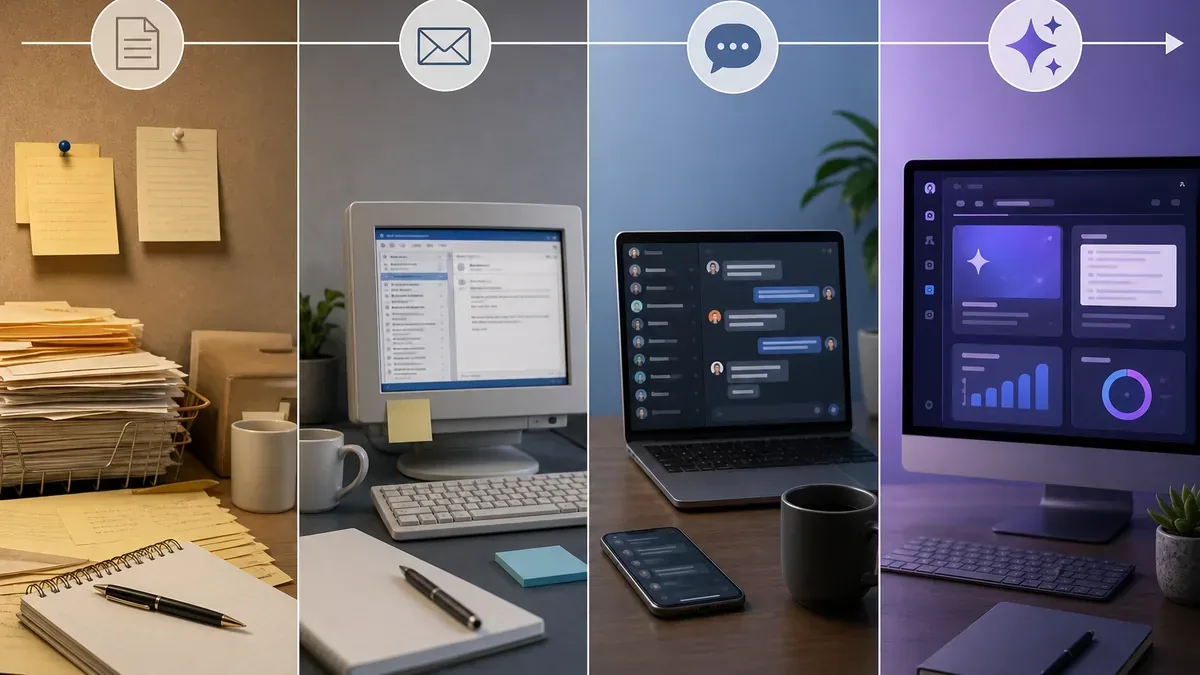
Key data points
- Email volume grew 300% between 2000 and 2020 before chat began absorbing routine coordination.
- Slack reached 10M daily users in 6 years-faster than email adoption in enterprises.
- Gen Z workers send 3× more chat messages per day than email compared to Gen X colleagues.
- AI-assisted communication is the fastest-adopted workplace technology since cloud document editing.
Communication has been the cornerstone of human civilization since the beginning of time. From ancient smoke signals to today's instant messaging platforms, the way we communicate has undergone a remarkable transformation. In this article, we'll trace the evolution of workplace communication and explore what the future holds for teams around the world.
The Ancient Roots of Communication
Long before the digital age, humans relied on various methods to convey messages across distances. Ancient Egyptians used hieroglyphics on temple walls, while the Greeks developed an extensive messenger system using runners and horses. The Romans perfected this with their famous cursus publicus-a state-run courier network that could deliver messages across the empire within days.
These early forms of communication were revolutionary for their time, but they were slow, limited, and accessible only to those in power. The average worker had no means of professional communication beyond face-to-face interaction.
The Industrial Revolution: A Communication Catalyst
The Industrial Revolution in the 18th and 19th centuries brought about significant changes in workplace communication. With the rise of factories and large organizations, the need for efficient communication became paramount.
"The single biggest problem in communication is the illusion that it has taken place." - George Bernard Shaw
The telegraph, invented in the 1830s, revolutionized long-distance communication for businesses. Suddenly, messages that once took weeks to deliver could be sent in minutes. This laid the foundation for the interconnected business world we know today.
The Telephone: Voice Across Miles
Alexander Graham Bell's telephone, patented in 1876, brought yet another dimension to workplace communication-real-time voice conversation. Businesses could now conduct negotiations, coordinate operations, and maintain relationships without physical proximity.
The telephone system evolved from manual switchboards to automated exchanges, eventually becoming a staple of every office. For decades, it remained the primary means of professional communication beyond face-to-face interaction.
The Digital Revolution
The late 20th century saw the emergence of computers and the internet, fundamentally changing how we communicate in the workplace. Email became the dominant form of business communication in the 1990s, offering speed, formality, and documentation that phone calls couldn't provide.
The 2000s introduced instant messaging platforms, video conferencing, and eventually, comprehensive collaboration tools. These innovations collapsed geographical barriers and enabled the rise of remote work.
Today's Unified Communication Landscape
Modern workplace communication is characterized by an unprecedented array of tools and platforms. Teams now have access to:
- Instant messaging for quick conversations
- Video conferencing for face-to-face meetings
- Project management tools for task-related updates
- Email for formal and external communications
- Shared workspaces for real-time collaboration
The challenge today isn't access to communication tools-it's managing the overwhelming number of options and ensuring effective, purposeful communication.
What Does the Future Hold?
As we look ahead, several trends are shaping the future of workplace communication:
- AI Integration: Artificial intelligence will automate routine communications, summarize lengthy conversations, and help prioritize important messages.
- Immersive Communication: Virtual and augmented reality may create more immersive remote collaboration experiences.
- Unified Platforms: The trend toward consolidated communication tools will continue, reducing tool fatigue and improving efficiency.
Frequently asked questions
What was the biggest shift in workplace communication?
The move from hierarchical, asynchronous memos to real-time, horizontal chat-now evolving again toward AI-mediated async with human-owned decisions.
Conclusion
The evolution of workplace communication reflects humanity's continuous drive to connect, collaborate, and create value together. From smoke signals to instant messaging, each advancement has expanded our ability to communicate beyond previous limitations.
At ZyncSpace, we're proud to be part of this ongoing evolution, providing modern teams with the tools they need to communicate effectively and build meaningful connections-no matter where they are in the world.